Every year on 14 August, Pakistani families around the world celebrate Independence Day with flags, green and white decorations and stories of pride. For children growing up in the UK, the day can feel like a distant event unless someone explains it. If you want to teach children about Pakistan Independence Day, this guide gives you a simple explanation, age-appropriate ways to talk about the history, and activities to make the day memorable.
Key takeaways
- Pakistan celebrates Independence Day on 14 August, marking independence from British rule in 1947.
- To teach children about Pakistan Independence Day, explain the story in simple, positive terms for younger children, and add more detail as they grow.
- The history includes hardship as well as hope. Share it gently and honestly.
- Flags, crafts, food and family stories bring the day to life.
What is Independence Day?
At the end of British rule in the Indian subcontinent in 1947, two independent countries came into being: Pakistan and India. Britannica records that both achieved independence on 14 and 15 August 1947, and Pakistan celebrates its Independence Day on 14 August. Muhammad Ali Jinnah, known as Quaid-e-Azam (“the great leader”), is remembered as the founder of Pakistan and its first Governor-General.
The words you might use with children are Azadi (آزادی, freedom) and Pakistan Zindabad (پاکستان زندہ باد, long live Pakistan), a well-known patriotic slogan.
How to teach children about Pakistan Independence Day by age
Ages 5 to 7: keep it simple and happy
You could say: “A long time ago, our families lived in a land ruled by another country. Many people wanted to have their own country where they could make their own decisions. On 14 August 1947, Pakistan became a new country. We celebrate to remember that day and to feel happy and proud.”
Focus on the flag, colours, songs and family celebrations. Avoid frightening details at this age.
Ages 8 to 10: add the story
Children of this age can grasp a little more:
- Different people had been working for years for more say in how they were governed.
- Leaders such as Muhammad Ali Jinnah and the poet Allama Iqbal are remembered in Pakistan’s story.
- When the new countries were created, many families had to move, which was both exciting and hard.
Invite questions and use a map to show where Pakistan and India are.
Ages 11 to 12: talk about the full picture
Older children can understand that independence was a moment of hope and also a time of great upheaval. Millions of people moved between the new countries, and many suffered loss and violence. It is important to be truthful without frightening them. Encourage them to read about the period at a level that suits them, and to ask relatives what they know. Let them see that history includes different perspectives.
The Pakistani flag
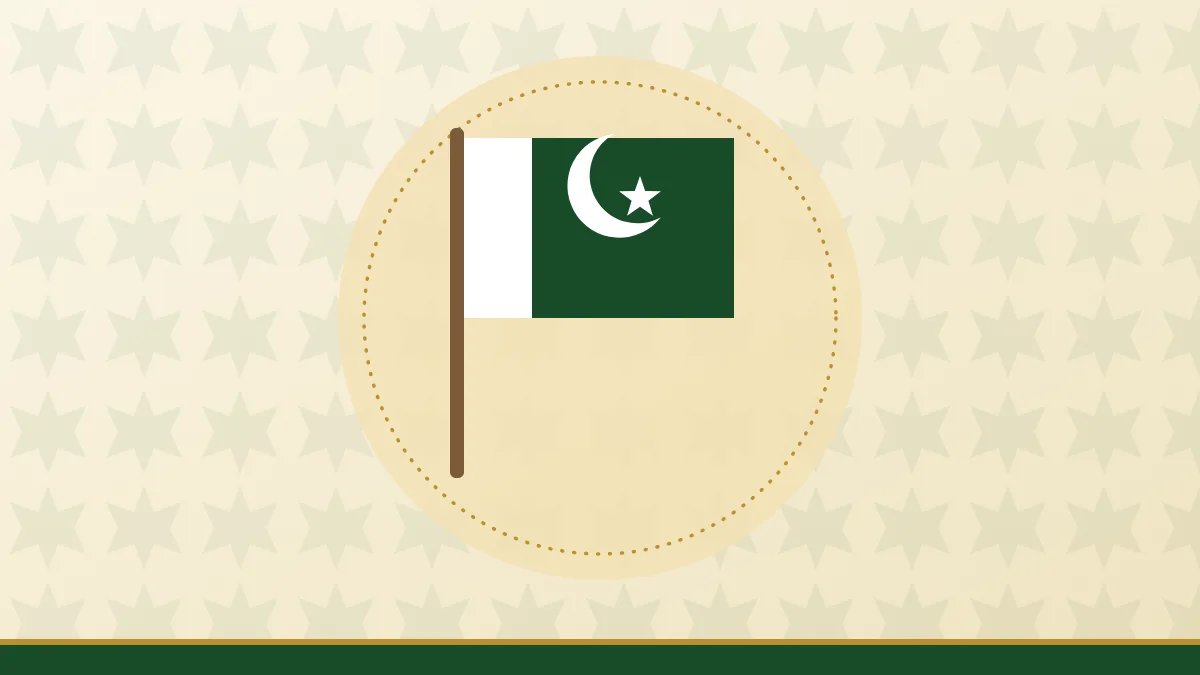
The flag is green with a white crescent and star, and a white vertical stripe on the left side. It is often explained as follows: green stands for the Muslim majority, white for religious minorities, the crescent for progress and the star for light and knowledge. Children enjoy learning to draw the flag correctly and can discuss what each part means. When displaying the flag, teach respect: keep it clean, do not let it touch the ground and fly it with care.
The national anthem
Pakistan’s national anthem is called Qaumi Tarana (قومی ترانہ). Its words are in a formal, Persian-influenced style that may be hard for children to follow, so listening together and explaining a few key words is plenty at first.
Activities to teach children about Pakistan Independence Day
- Make a flag. Cut green and white paper, add a crescent and star and glue it to a straw or stick.
- Create bunting. Use green and white triangles on string to decorate a room.
- Cook a special treat. Make green and white sweets or a simple dish, and name the ingredients in Urdu.
- Hold an “Azadi quiz.” Prepare ten questions about Pakistan, such as the capital (Islamabad), the national language (Urdu), a famous mountain (K2) or a famous poet (Allama Iqbal). Let children write some questions too.
- Look at landmarks. Find the Minar-e-Pakistan, the Badshahi Mosque, the Lahore Fort or the Faisal Mosque online or in a book, and talk about what children notice. See our Pakistan facts for kids.
- Listen to patriotic songs. Learn one together and explain the words.
- Interview a relative. Ask a grandparent what they remember about family stories connected to this time. Some memories may be painful, so let them decide how much to share.
- Dress in green and white. It is a simple way for children to take part.
Celebrating in the UK
Many communities hold events around 14 August, such as flag raisings, family gatherings and cultural evenings. Check local community centres, mosques and cultural associations for what is on in your area. If you celebrate at home, a small family tradition, such as a picnic in the park or a special dinner, can become an annual highlight.
You might also connect what you teach children about Pakistan Independence Day with what your child learns at school about British history and values. Comparing different stories of nationhood can spark thoughtful conversations. For a broader look at celebrations through the year, read Pakistani festivals for children.
Tips to teach children about Pakistan Independence Day and difficult history
- Be honest, but gentle. Do not hide that there was suffering, and do not overload young children.
- Let children ask questions. If you do not know an answer, say so and find out together.
- Present different viewpoints. Avoid portraying any group as simply good or bad.
- Focus on values. Freedom, courage, responsibility and care for others are themes every child can understand.
Frequently asked questions
Do we celebrate on 14 or 15 August?
Pakistan celebrates Independence Day on 14 August. India celebrates on 15 August.
Is it okay to celebrate Pakistan’s Independence Day while being British?
Many British-Pakistani families do. Celebrating heritage and being part of British society are not in conflict. Read helping British-Pakistani children stay connected to their roots.
How do I explain it if my child’s friends are not Pakistani?
To teach children about Pakistan Independence Day when their friends are not Pakistani, say it is a special day for your family that marks the birth of a country, a bit like how other countries celebrate their national days. Invite their curiosity.
Learn about Pakistan’s story with other children
Our Sunday classes in Slough introduce children aged 5 to 12 to Pakistan’s history, heritage and traditions in an age-appropriate and interesting way.
Related reading
- Pakistani festivals for children
- Pakistani arts and crafts for children
- How to teach children about Pakistani culture while living in the UK